

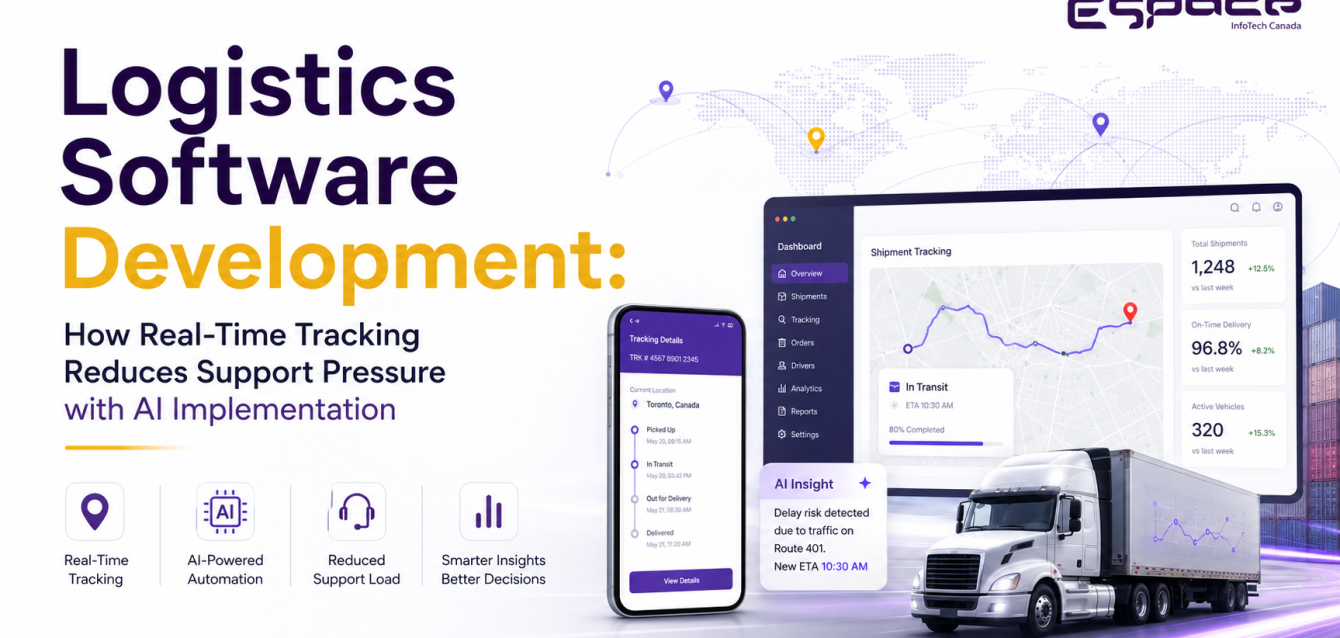
In logistics, customers do not only care about delivery. They care about visibility.
When a shipment is delayed, missing, stuck in transit, or marked incorrectly, the first reaction is usually simple: contact support. One customer wants to know where the parcel is. Another asks when the truck will arrive. A warehouse manager needs an updated ETA. A business client wants proof of delivery.
When these questions come repeatedly, support teams become overloaded.
This is where logistics software development becomes valuable. A well-built logistics platform with real-time tracking, automated notifications, AI-powered insights, and self-service portals can reduce pressure on support teams while improving customer trust.
For logistics companies in Canada and beyond, the goal is not just to move goods faster. The goal is to make the delivery journey more transparent, predictable, and easier to manage.
Why Logistics Support Teams Face So Much Pressure
Support pressure in logistics usually comes from uncertainty.
Customers contact support when they cannot answer basic questions on their own. Where is my shipment? Why is it delayed? When will it arrive? Who has received it? Can I change the delivery address? Is the driver nearby?
If the system does not provide clear answers, customers will call, email, or message support again and again.
The problem becomes bigger when internal teams also work with disconnected tools. Dispatchers may use one system. Drivers may use another. Warehouse teams may update status manually. Customer service may not have real-time access to shipment data.
This creates delays, repeated questions, and frustrated customers.
A logistics software platform solves this by creating one connected source of truth.
What Is Logistics Software Development?
Logistics software development means designing and building digital systems that help businesses manage shipments, fleets, warehouses, routes, drivers, customers, documents, tracking, and delivery updates.
A custom logistics platform may include order management, dispatch planning, real-time tracking, route optimization, fleet monitoring, customer portals, driver apps, proof of delivery, reporting dashboards, and AI automation.
For growing logistics companies, custom software can replace manual processes and disconnected spreadsheets with a centralized system.
The result is better visibility for customers and better control for operations teams.
How Real-Time Tracking Reduces Support Pressure
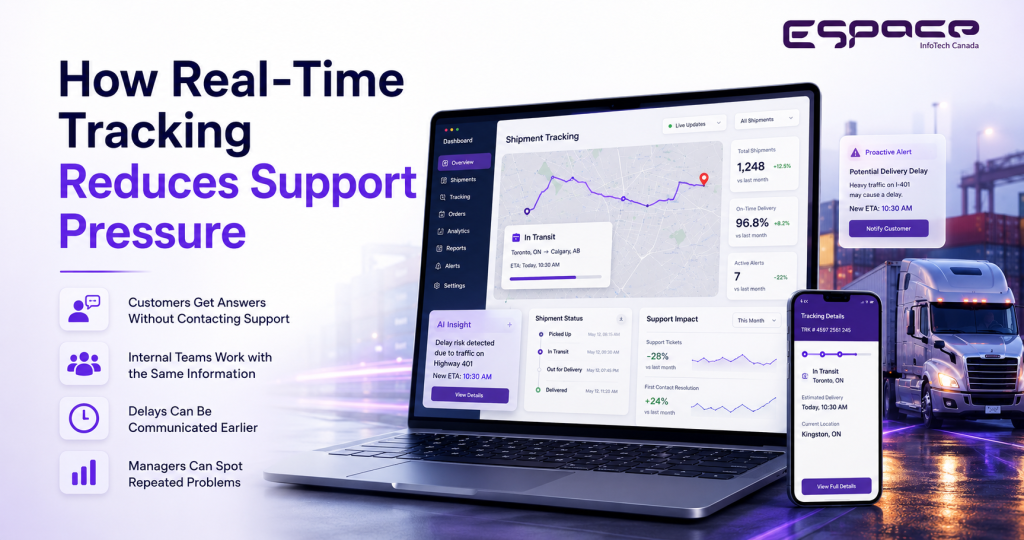
Customers Get Answers Without Contacting Support
The biggest benefit of real-time tracking is self-service visibility.
When customers can see the latest shipment location, status, ETA, delay reason, and delivery confirmation from a portal or tracking link, they do not need to contact support for every update.
This reduces repetitive “Where is my order?” inquiries.
It also improves trust because customers feel informed instead of ignored.
Internal Teams Work with the Same Information
Real-time tracking also helps internal teams.
Customer support, dispatch, warehouse staff, drivers, and managers can all see updated shipment information from the same system. This reduces confusion and prevents teams from giving different answers to the same customer.
When everyone works from one dashboard, problem-solving becomes faster.
Delays Can Be Communicated Earlier
Customers become more frustrated when delays are discovered late.
A good logistics platform can detect delays early and send automatic notifications. For example, if a vehicle is stuck in traffic or a route is delayed, the system can update the ETA and inform the customer before they need to ask.
That simple proactive update can prevent many support tickets.
Managers Can Spot Repeated Problems
Real-time tracking also creates useful data. Managers can see patterns such as repeated delays, high-volume support routes, driver performance issues, warehouse bottlenecks, or failed delivery trends.
Instead of only reacting to complaints, logistics businesses can fix the root causes.
Core Features of Logistics Software
A strong logistics software platform should support both customer experience and internal operations.
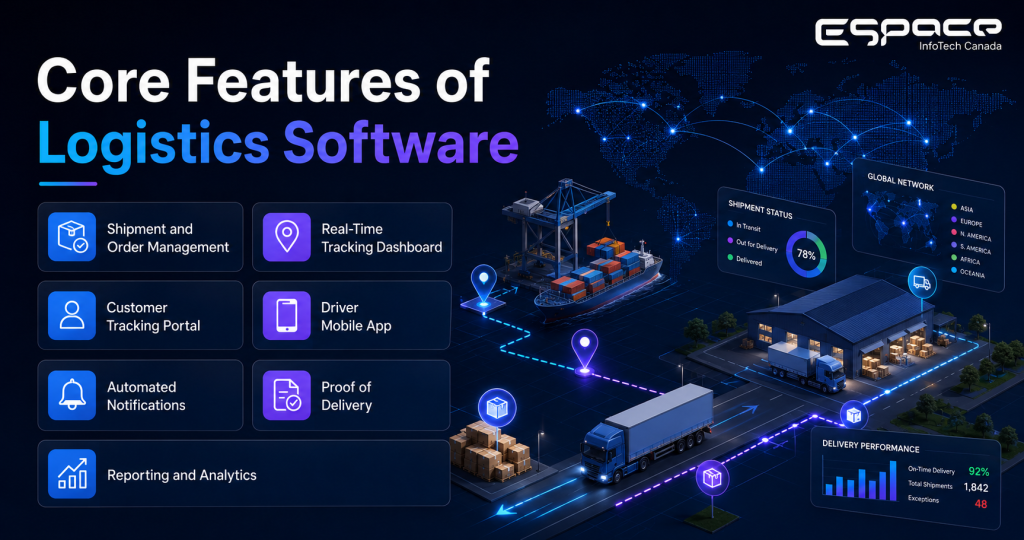
Shipment and Order Management
The system should allow teams to create, assign, update, and track shipments from one place. It should include order details, pickup location, delivery address, customer information, package status, delivery priority, and special instructions.
Real-Time Tracking Dashboard
A real-time dashboard should show shipment status, vehicle location, ETA, route progress, delayed orders, completed deliveries, and failed delivery attempts.
This dashboard helps support teams answer questions quickly and helps managers monitor operations.
Customer Tracking Portal
A customer portal allows users to check shipment status without contacting support. It may include tracking numbers, delivery timeline, live status, ETA, proof of delivery, invoice information, and communication history.
This is one of the most effective ways to reduce support workload.
Driver Mobile App
Drivers need a simple mobile app to view assigned deliveries, update status, upload proof of delivery, capture signatures, report issues, and communicate with dispatch.
The app should be fast, easy to use, and designed for field conditions.
Automated Notifications
Automated notifications can update customers through email, SMS, or app alerts. These may include pickup confirmation, out-for-delivery status, delay notices, delivery confirmation, and failed delivery alerts.
For Canadian businesses, automated commercial messages should be planned carefully. CASL requires organizations sending commercial electronic messages to follow key requirements such as consent, identification information, and an unsubscribe mechanism.
Proof of Delivery
Proof of delivery can include photos, signatures, timestamps, GPS location, recipient name, and delivery notes. This helps reduce disputes and gives customers confidence.
Reporting and Analytics
Logistics managers need reports on delivery performance, route efficiency, delay reasons, driver activity, failed deliveries, support ticket volume, and customer satisfaction.
Good reporting helps teams make better operational decisions.
AI Implementation in Logistics Software
AI can make logistics software more useful, but it should not be added only to make the platform look advanced. The best AI features solve practical business problems.
AI-Powered ETA Prediction
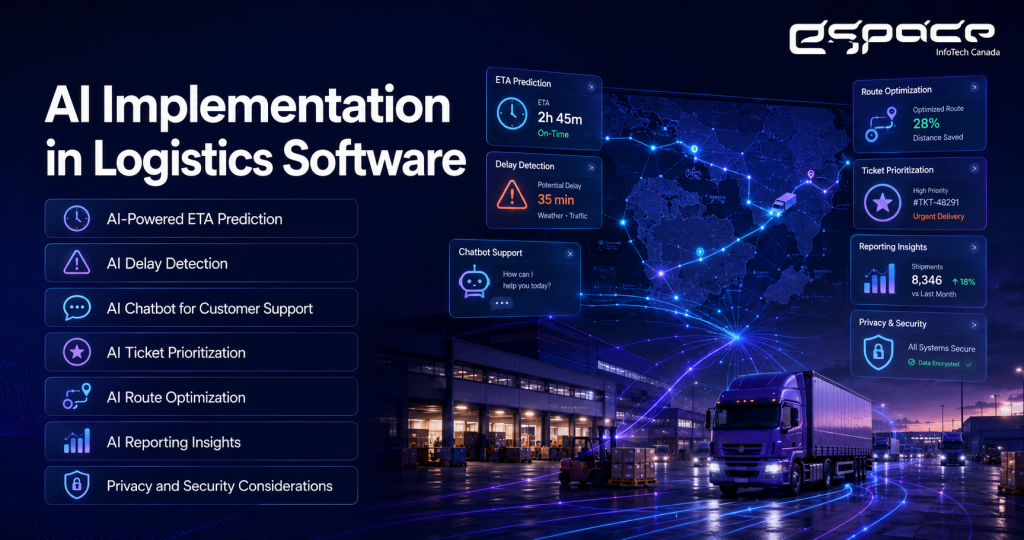
AI can analyze route history, traffic patterns, driver activity, weather signals, distance, pickup delays, and delivery performance to generate smarter ETA predictions.
This helps customers receive more accurate updates and helps support teams avoid repeated follow-up calls.
AI Delay Detection
AI can detect when a shipment is likely to be delayed before the customer complains. It can identify route issues, late pickups, long idle time, warehouse delays, or abnormal delivery patterns.
Once the system detects a risk, it can alert dispatchers or trigger automatic customer updates.
AI Chatbot for Customer Support
An AI chatbot can answer common logistics questions such as shipment status, delivery time, tracking number issues, return process, service area, and proof of delivery.
This does not replace the support team. It helps them by handling repetitive questions and escalating complex cases to a human agent.
AI Ticket Prioritization
Not every support request has the same urgency. AI can help classify and prioritize tickets based on shipment value, delivery delay, customer type, complaint history, and urgency.
This helps support teams focus on the most important issues first.
AI Route Optimization
AI can suggest better delivery routes by analyzing distance, traffic, delivery windows, vehicle capacity, and historical route performance.
This can reduce delays, fuel usage, and driver workload.
AI Reporting Insights
Instead of only showing charts, AI can explain what is happening in simple language. For example, it can highlight that most support tickets came from delayed deliveries in a specific route or that failed deliveries increased after a warehouse change.
This helps managers act faster.
Privacy and Security Considerations in Logistics Software Development
Logistics software often handles personal and business information such as customer names, addresses, phone numbers, delivery instructions, payment details, and shipment records.
In Canada, PIPEDA sets the ground rules for how private-sector organizations handle personal information during commercial activities. Businesses that operate in Canada and handle personal information across provincial or national borders may be subject to PIPEDA requirements.
Because of this, logistics platforms should be built with privacy and security from the beginning.
Important security features include role-based access control, data encryption, secure authentication, audit logs, backup and recovery, secure APIs, driver permission controls, and admin activity monitoring.
Security is not only a technical requirement. It is part of customer trust.
How to Build a Better Logistics Software Platform
Start by mapping the full delivery workflow. Understand how orders are created, how drivers are assigned, how shipments are updated, how customers ask for support, and where delays usually happen.
Then define user roles. Admins, dispatchers, drivers, warehouse teams, customers, and support agents all need different dashboards and access levels.
Next, build the core modules first: order management, real-time tracking, driver app, customer portal, notifications, proof of delivery, and reporting.
After that, add AI where it solves real problems. Start with ETA prediction, delay detection, chatbot support, route optimization, ticket prioritization, and reporting insights.
Finally, test the system with real drivers, support agents, and customers before launch. Logistics software must work in real-world conditions, not only in a clean demo environment.
Conclusion
Real-time tracking is more than a map feature. It is a support pressure reducer, customer trust builder, and operations improvement tool.
When customers can see accurate delivery updates, support teams receive fewer repetitive questions. When internal teams share the same data, issue resolution becomes faster. When AI is added with purpose, logistics companies can predict delays, prioritize tickets, optimize routes, and explain performance more clearly.
For logistics businesses, the future is not only faster delivery. It is smarter visibility.
Espace Infotech Canada Inc. can help you build custom logistics software with real-time tracking, AI automation, customer portals, driver apps, and scalable dashboards designed for modern logistics operations.
FAQ
How does real-time tracking reduce support pressure?
Real-time tracking reduces support pressure by allowing customers and internal teams to view shipment status, ETA, delay updates, and proof of delivery without repeatedly contacting support.
How can AI improve logistics software?
AI can improve logistics software through ETA prediction, delay detection, route optimization, customer support chatbots, ticket prioritization, and automated reporting insights.
What features should logistics software include?
A logistics platform should include order management, real-time tracking, driver apps, customer portals, automated notifications, proof of delivery, dispatch management, and reporting dashboards.
Is privacy important in logistics software?
Yes. Logistics software handles customer and delivery information, so businesses should use secure authentication, encryption, role-based access, audit logs, and proper data protection practices.
Can Espace Infotech Canada build logistics software?
Yes. Espace Infotech Canada Inc. can build custom logistics software, real-time tracking systems, driver apps, customer portals, AI automation tools, and logistics dashboards.