

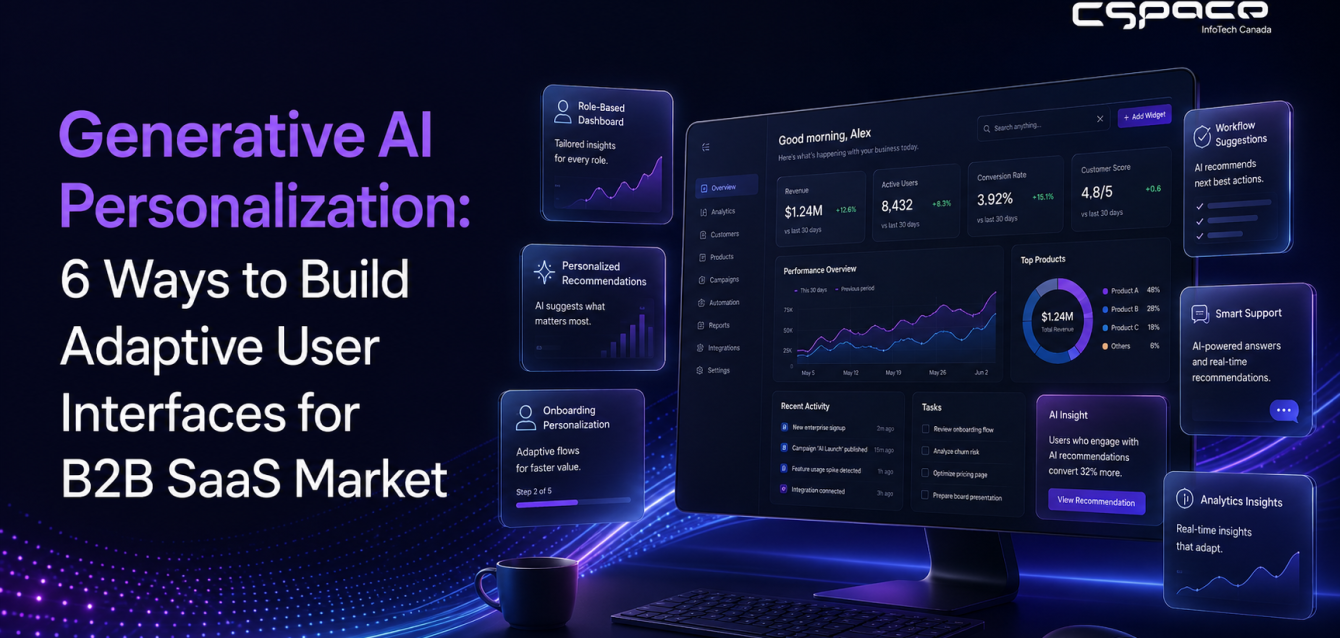
Generative AI personalization is changing how B2B SaaS platforms are designed, used, and improved. In Canada’s SaaS market, users now expect more than a clean dashboard or a long feature menu. They want software that understands their role, business goals, workflow, and next best action.
A CEO may need business summaries. A sales manager may need pipeline insights. A support lead may need ticket trends. A finance user may need invoices, payment updates, and reports.
The same platform can serve all of them, but the experience should not feel the same for everyone.
That is where generative AI personalization becomes valuable. It helps SaaS platforms adapt dashboards, onboarding flows, content, recommendations, support messages, and user journeys based on each customer’s context.
For Canadian B2B SaaS companies, this is not just a design upgrade. It is a smarter way to improve user experience, reduce friction, increase product adoption, and build stronger customer relationships.
What Is Generative AI Personalization?
Generative AI personalization means using artificial intelligence to create more relevant digital experiences for different users inside a SaaS platform.
Instead of showing every user the same dashboard, same menu, and same support journey, the system can adjust the experience based on role, behavior, company type, account history, product usage, and business needs.
In a B2B SaaS product, this may include:
- Personalized dashboards
- Role-based navigation
- AI-generated insights
- Smart onboarding flows
- Contextual support suggestions
- Feature recommendations
- Industry-specific user journeys
- Automated workflow suggestions
The goal is not to make the product look more “AI-powered.” The goal is to make the product easier, faster, and more useful. Good personalization should feel natural. It should help users find what they need without making the interface confusing or unpredictable.
Why Generative AI Personalization Matters for B2B SaaS Canada
Canadian B2B SaaS companies often serve clients across many industries, including retail, healthcare, finance, logistics, education, real estate, manufacturing, and professional services.
Each industry has different workflows, decision-making steps, compliance needs, and reporting requirements.
A fixed user interface may work when the product is small. But as the SaaS platform grows, the same experience for every user can become limiting. Users may struggle to find the right features, onboarding may feel too generic, and support teams may receive repeated questions that the interface should already help answer.
Generative AI personalization gives SaaS companies a way to keep the core product stable while making the user experience more relevant for different customers.
This can support:
- Faster onboarding
- Better feature discovery
- Lower support pressure
- Higher product adoption
- Stronger customer retention
- More useful customer insights
In simple terms, personalization helps users get value from the platform faster.
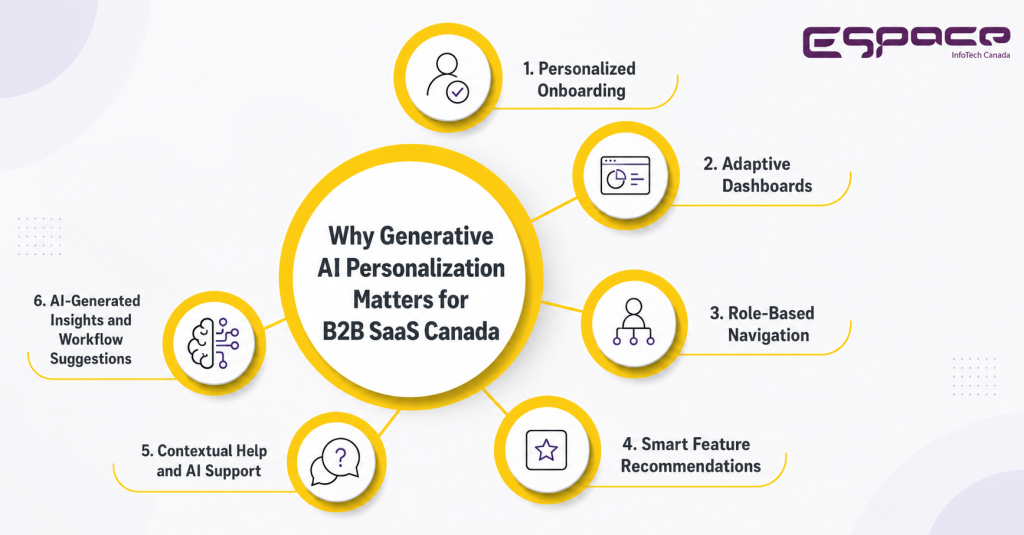
1. Personalized Onboarding
Many SaaS users leave a platform early because onboarding feels too long, too generic, or too difficult to follow. Generative AI can make onboarding more relevant by adjusting the setup journey based on user role, company size, industry, and business objective.
For example, a retail client may receive onboarding steps related to inventory, POS, and customer data. A healthcare client may receive guidance around appointment workflows, communication, and reporting. A startup founder may receive a shorter onboarding path focused on quick launch and core features. This makes onboarding feel less like a checklist and more like guided support. When users understand the product faster, they are more likely to continue using it.
2. Adaptive Dashboards
A dashboard should not be a place where every possible metric is displayed at once. It should help users understand what matters most. With generative AI personalization, dashboards can adapt based on user activity, role, and business priority.
A business owner may see revenue trends and growth alerts. A marketing manager may see campaign performance. A sales manager may see lead activity and pipeline movement. A support manager may see open tickets, response times, and customer issues. This reduces noise and helps users make decisions faster. The best dashboard is not always the one with the most data. It is the one that helps the user take the right action.
3. Role-Based Navigation
As B2B SaaS products grow, they often become more complex. More features are added. More settings appear. More reports become available. The challenge is simple: how do you keep the platform powerful without making it difficult to use? Role-based navigation can help.
Generative AI can identify which features, reports, shortcuts, and actions are most relevant for each user. Instead of forcing every user to browse the same menu, the system can prioritize the tools that match their job. This makes the interface feel cleaner while still keeping advanced features available when needed. For SaaS companies, this can reduce confusion and improve daily product usage.
4. Smart Feature Recommendations
Many SaaS platforms have valuable features that customers never discover. This creates a silent problem. The product may be powerful, but users do not always know how to use it fully. Generative AI personalization can recommend features based on user behaviour.
For example, if a user manually exports reports every week, the platform can suggest automated reporting. If a sales team tracks leads in spreadsheets, the system can recommend CRM workflow automation. If a customer repeatedly asks similar support questions, the interface can suggest relevant training resources or setup improvements. The purpose is not to push random features. The purpose is to guide users toward tools that solve real problems.
5. Contextual Help and AI Support
Traditional help centers often require users to search for answers, which can happen after they are already frustrated.
AI-powered support can make help more proactive. Generative AI can detect when a user is stuck and provide relevant guidance directly within the interface. This may include short explanations, help articles, chatbot responses, step-by-step instructions, or recommended actions. For B2B SaaS companies, this can reduce the number of repetitive support tickets and improve customer satisfaction. The user receives help at the right moment without having to leave their workflow.
6. AI-Generated Insights and Workflow Suggestions
Generative AI personalization can also help users understand what their data means. Instead of just showing charts and reports, the system can explain important patterns in simple language.For example:
“Your support tickets increased this week.”
“This customer segment has lower product adoption.”
“Your sales team is manually repeating this workflow.”
“This report can be automated.”
These insights help users move from data to decision-making. For busy teams, this is important because they often don’t have time to analyze every report manually.AI can help highlight what needs attention.
The Role of Data in Generative AI Personalization
AI personalization depends on clean and structured data.
A SaaS platform may use data from user profiles, CRM systems, product analytics, billing history, support tickets, customer communication, role settings, workflow activity, and account type.However, more data does not automatically mean better personalization.The data must be accurate, relevant, secure, and properly organized.If the data is poor, disconnected, or outdated, the AI experience can become inaccurate or unhelpful.This is why SaaS companies should treat data architecture as part of their product strategy, not as a technical detail to fix later.
Privacy-First Personalization for Canadian SaaS Companies
Personalization depends on user and customer data, which means trust must be part of the plan from the beginning. For Canadian SaaS companies, privacy should be carefully considered when collecting, using, and storing customer information.A privacy-first approach should consider:
- What data is collected
- Why the data is needed
- How users are informed
- How consent is managed
- How sensitive information is protected
- How AI decisions are reviewed
- How users can control their preferences
Good personalization should feel helpful, not intrusive. This is especially important for SaaS platforms serving healthcare, finance, legal, education, HR, or enterprise clients.
How to Build an AI-Personalized SaaS Interface
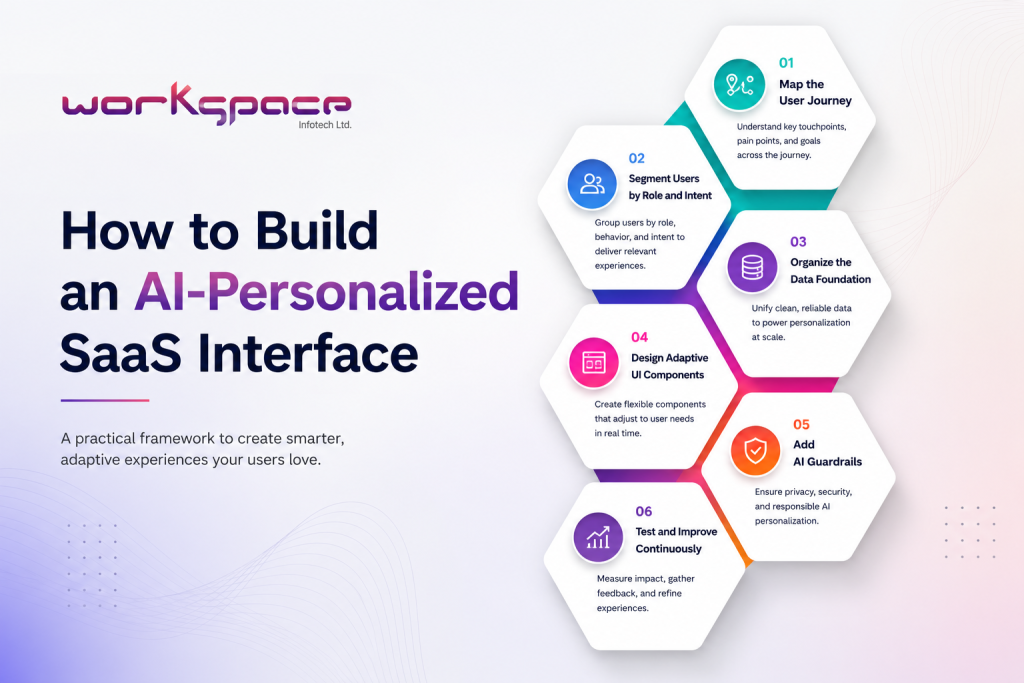
Step 1: Map the User Journey
Start by identifying where users face friction. Look at onboarding, dashboard usage, reporting, support requests, feature adoption, and renewal risks.
Step 2: Segment Users by Role and Intent
Group users by role, industry, account type, usage pattern, and business objective. This helps define what should be personalized.
Step 3: Organize the Data Foundation
Connect important systems such as CRM, analytics, support, billing, and product activity. Clean data is the backbone of effective AI personalization.
Step 4: Design Adaptive UI Components
Build flexible interface components such as dynamic dashboards, smart cards, personalized menus, contextual prompts, and AI-generated summaries.
Step 5: Add AI Guardrails
Define what AI can change, what must stay fixed, and when human approval is required. Guardrails protect brand consistency, compliance, and user trust.
Step 6: Test and Improve Continuously
Measure user engagement, task completion, onboarding success, support reduction, feature adoption, retention, and customer satisfaction.
Why Choose Custom SaaS Development for AI Personalization?
Ready-made tools can support basic personalization, but B2B SaaS platforms often need deeper flexibility.
Custom SaaS development is useful when your product requires complex workflows, role-based dashboards, enterprise integrations, industry-specific features, advanced reporting, AI automation, or custom customer portals.A custom-built SaaS platform can be designed around your real business process.It gives you more control over data, user experience, integrations, security, and scalability.For Canadian SaaS companies that want to compete with stronger digital products, this flexibility can become a long-term advantage.
Final Thoughts
Generative AI personalization is changing how B2B SaaS platforms are designed and used.
For Canadian SaaS companies, adaptive user interfaces can improve onboarding, simplify workflows, increase engagement, reduce support pressure, and create stronger customer relationships.But success requires more than adding AI features.It needs clean data, strong UX strategy, privacy-first planning, clear business rules, and continuous improvement.The future of SaaS user experience is not just clean design.It is intelligent, adaptive, and customer-aware design. If your SaaS platform still gives every user the same dashboard, the same onboarding flow, and the same support journey, now is the right time to rethink the experience.
Ready to build an AI-powered SaaS platform for the Canadian market? Espace Infotech Canada Inc. can help you design, develop, and scale custom SaaS solutions with generative AI personalization built around your customers.
Whether you are building a new SaaS product or modernizing an existing platform, Espace Infotech Canada can help you create a smarter, more personalized user experience.
FAQ
What is generative AI personalization in SaaS?
Generative AI personalization in SaaS means using AI to create more relevant user experiences based on customer behavior, user role, account type, activity history, and business context.
Why is generative AI personalization important for B2B SaaS companies?
It helps SaaS companies improve onboarding, product adoption, customer engagement, retention, and user satisfaction by making the platform more relevant for each user.
How can AI personalize a SaaS dashboard?
AI can personalize a SaaS dashboard by showing role-specific metrics, alerts, recommendations, reports, and next-best actions based on how the user interacts with the platform.
Is generative AI personalization suitable for Canadian businesses?
Yes. Canadian businesses can use generative AI personalization, but they should follow privacy-first practices and handle customer data responsibly under applicable privacy laws such as PIPEDA.
Does every SaaS company need custom AI personalization?
Not every SaaS company needs advanced personalization immediately. However, businesses with complex workflows, multiple user roles, enterprise clients, or industry-specific needs can benefit from custom AI personalization.