


Real estate SaaS platforms are changing how modern real estate businesses manage listings, leads, clients, documents, and communication. For agents, brokers, property managers, developers, and proptech startups, a simple listing website is no longer enough.
Clients now expect a smoother digital experience. Buyers want relevant property suggestions. Sellers want listing performance updates. Tenants want quick answers. Landlords want visibility. Agents want a CRM that helps them follow up at the right time instead of managing everything manually.
This is where AI becomes useful. Not as a fancy add-on, but as a practical layer that helps real estate teams save time, reduce missed opportunities, and deliver a better client experience.
A strong real estate SaaS platform should connect property listings, CRM, client portals, lead management, documents, reporting, integrations, and AI-powered automation into one easy-to-use system.
What Are Real Estate SaaS Platforms?
Real estate SaaS platforms are cloud-based software systems that help real estate businesses manage daily operations through a web or mobile platform.
Unlike a basic website, a SaaS platform supports multiple roles and workflows. Agents can manage leads. Admins can approve listings. Clients can log in to view updates. Managers can track reports. Property owners can check activity. Everyone works from one connected system, but with the right level of access.
For Canadian real estate businesses, this is especially useful because teams often manage many moving parts: property data, lead sources, communication channels, documents, appointments, marketing updates, and reporting.
A good SaaS platform brings these pieces together.
Why Real Estate Businesses Need Smarter SaaS Platforms
Many real estate teams still depend on disconnected tools. Listings may be on one platform, leads in another, documents in cloud folders, and communication scattered across email, phone, SMS, and messaging apps.
This creates everyday problems.
Leads get missed. Follow-ups are delayed. Clients ask the same questions repeatedly. Property information becomes outdated. Managers struggle to understand which listings, agents, or lead sources are performing well.
Real estate SaaS platforms help solve these problems by creating a single source of truth.
The goal is not to replace human relationships. Real estate will always need trust, negotiation, and personal guidance. The goal is to remove unnecessary manual work so teams can focus more on clients.
Real Estate SaaS Platforms for Better Listing Management
Property listings are the first impression for many clients. If listings are outdated, incomplete, or difficult to search, users may leave before contacting an agent.
A strong listing module should allow teams to add, edit, approve, publish, and update properties from one dashboard. It should support property type, location, price, availability, photos, videos, floor plans, amenities, agent details, open house schedules, and listing status.
For Canadian platforms, listing data may also involve approved industry workflows. CREA describes REALTOR.ca DDF as a managed service that helps REALTORS and broker owners share listings with third-party websites and access more listings for their own websites. The REALTOR.ca DDF Web API documentation also explains that approved DDF clients can request and receive CREA listing data for website display based on brokerage permissions.
This means listing systems should be planned with data accuracy, permissions, and integration rules in mind.
Real Estate CRM Software for Stronger Lead Management
A real estate CRM is one of the most important parts of a SaaS platform. It helps agents manage leads, contacts, property interests, follow-up tasks, communication history, and pipeline stages.
For example, when a buyer submits an inquiry from a listing page, the CRM should automatically create a lead, connect that lead with the property, assign it to the right agent, and create a follow-up reminder.
This helps agents respond faster and avoid losing serious prospects.
A good CRM should include:
- Lead capture
- Contact profiles
- Property interest tracking
- Agent assignment
- Follow-up reminders
- Pipeline stages
- Call, email, and message history
- Task management
- Lead source tracking
- Activity logs
The CRM should feel less like a database and more like a daily assistant for the sales team.
AI Implementation in Real Estate SaaS Platforms
AI can make real estate SaaS platforms more useful when it solves real workflow problems. It should not be added just to make the product look advanced.
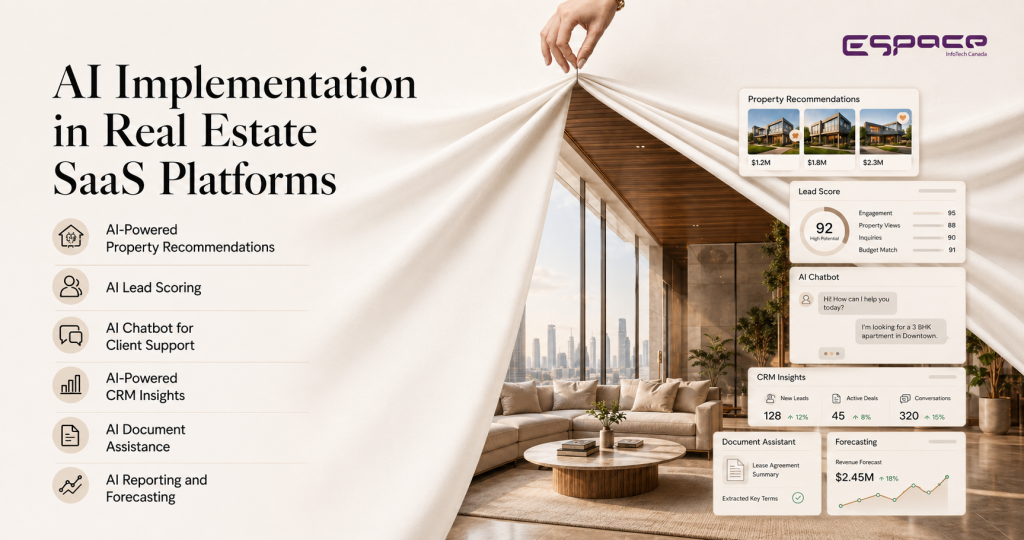
AI-Powered Property Recommendations
AI can study user behavior, saved listings, search history, budget, preferred location, property type, and engagement patterns to recommend better property matches.
Instead of showing every available listing, the platform can show the most relevant options first.
This saves time for users and helps agents start better conversations.
AI Lead Scoring
Not every lead is ready to buy, rent, or sell immediately. Some users are casually browsing, while others may be close to booking a viewing or making a decision.
AI can score leads based on repeated visits, saved properties, inquiry frequency, budget match, location interest, and response behavior.
This helps agents focus on serious opportunities first.
AI Chatbot for Client Support
A real estate AI chatbot can answer common questions about property availability, viewing times, application steps, required documents, neighborhood details, and basic service information.
It does not replace agents. It supports them.
The chatbot can handle repetitive questions, collect initial information, and pass serious inquiries to the right person.
AI-Powered CRM Insights
AI can help agents understand what to do next. It can suggest follow-up reminders, identify inactive leads, recommend similar properties, summarize conversation history, and alert agents when a client shows strong intent.
This makes CRM more proactive and less manual.
AI Document Assistance
Real estate involves many documents. AI can help organize files, extract key details, summarize long documents, flag missing information, and support faster document review.
Human review should still remain part of the process, especially for legal or financial documents. AI should assist, not replace professional judgment.
AI Reporting and Forecasting
Managers can use AI to understand business performance more clearly. AI can identify which listings get the most attention, which lead sources convert better, which agents may need support, and which clients need faster follow-up.
Instead of only showing charts, AI can explain what the data means in simple language.
Client Portals for Real Estate Businesses
Client portals are one of the best ways to improve transparency.
A buyer portal can show saved listings, recommended properties, viewing schedules, documents, messages, and offer updates.
A seller portal can show listing performance, inquiries, viewing feedback, marketing activity, reports, and shared documents.
A tenant portal can include applications, lease documents, payment status, maintenance requests, and communication history.
A landlord portal can show tenant updates, financial summaries, property performance, documents, and service requests.
When clients can see updates on their own, they feel more informed. That reduces repetitive communication and builds trust.
Security and Privacy in Real Estate SaaS Platforms
Real estate platforms collect personal information such as names, contact details, property preferences, communication history, uploaded documents, and sometimes financial details.
In Canada, PIPEDA sets the ground rules for how private-sector organizations collect, use, and disclose personal information during commercial activities. The Office of the Privacy Commissioner of Canada also explains that organizations should collect, use, or disclose personal information by fair and lawful means, with consent, and for reasonable stated purposes.
Because of this, security should be planned from the beginning.
Important features include role-based access control, secure authentication, encryption, audit logs, secure file storage, backup and recovery, consent management, session timeout, and admin activity monitoring.
If the platform sends property alerts, newsletters, or promotional follow-ups, businesses should also consider CASL. The CRTC explains that commercial electronic messages generally require consent, identification information, and an unsubscribe mechanism.
Useful Integrations for Real Estate SaaS Platforms
A real estate SaaS platform becomes stronger when it connects with the tools the business already uses.
Useful integrations may include:
- Listing data sources
- Map services
- Email and SMS tools
- Calendar systems
- Payment gateways
- E-signature platforms
- Accounting software
- Analytics tools
- Existing CRM systems
- Document storage tools
The goal is not to add more tools. The goal is to reduce duplicate work and keep the business connected.
How Espace Infotech Canada Can Help
Espace Infotech Canada Inc. helps real estate businesses, brokerages, property managers, and proptech startups build scalable digital platforms.
Our team can support real estate SaaS development, property listing platforms, AI-powered CRM systems, client portal development, lead automation workflows, AI chatbot implementation, document management systems, agent dashboards, reporting tools, and third-party integrations.
Whether you are building a new proptech product or modernizing an existing platform, Espace Infotech Canada can help you create a secure, scalable, and user-friendly solution for the Canadian market.
Conclusion
Real estate SaaS platforms are no longer just about showing properties online. They are about creating a connected experience for agents, clients, managers, and property teams.
A strong platform should combine listings, CRM, lead automation, client portals, documents, reporting, security, integrations, and AI-powered features.
For Canadian real estate businesses, the right software can reduce manual work, improve lead management, create better client transparency, and support long-term growth.
Espace Infotech Canada Inc. can help you build custom real estate SaaS platforms with AI-powered CRM, smart listings, client portals, and scalable workflows designed for the Canadian market.
FAQ
How can AI improve real estate SaaS platforms?
AI can improve real estate SaaS platforms through property recommendations, lead scoring, AI chatbots, CRM insights, document assistance, and reporting summaries.
Is privacy important for real estate SaaS platforms in Canada?
Yes. Real estate SaaS platforms collect personal information, so businesses should consider privacy requirements such as PIPEDA and build strong security controls into the platform.
Can Espace Infotech Canada build AI-powered real estate SaaS platforms?
Yes. Espace Infotech Canada Inc. can build AI-powered real estate SaaS platforms, listing systems, CRM tools, client portals, dashboards, automation workflows, and third-party integrations.