

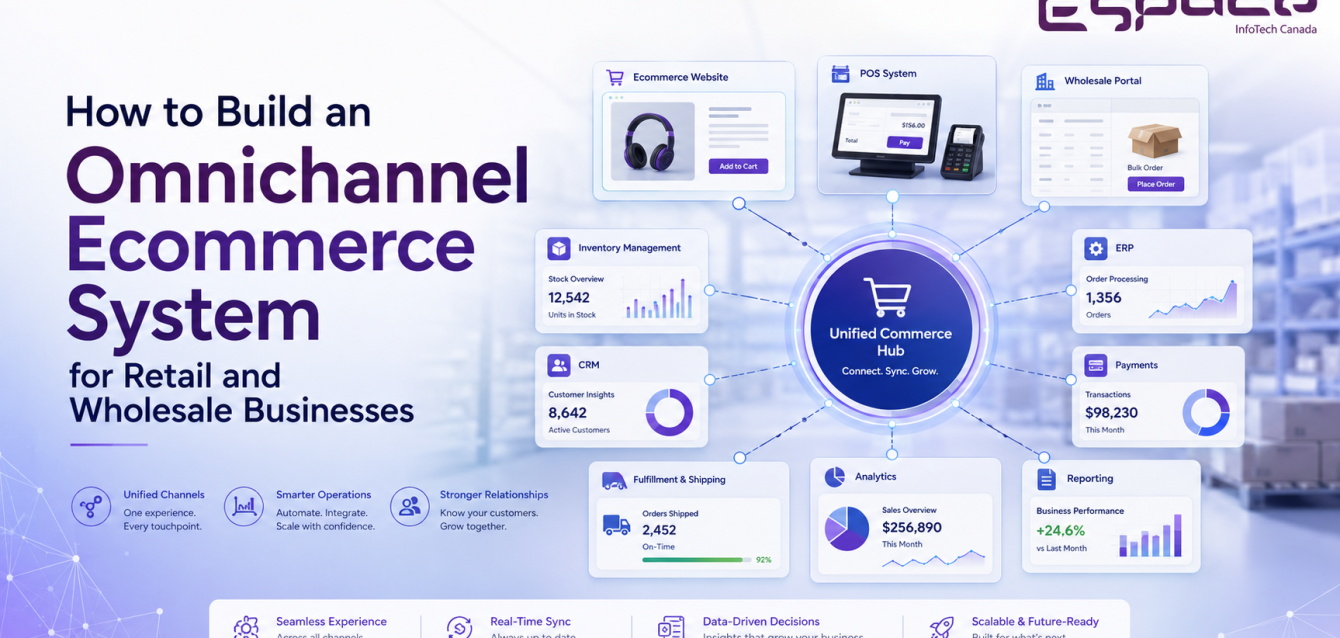
Modern commerce no longer happens in one place. Customers may discover a product on social media, compare it on a website, buy it through a mobile app, pick it up from a store, or place a repeat wholesale order through a customer portal.
For retail and wholesale businesses, this creates strong growth opportunities. But it also brings a serious operational challenge: how do you keep products, orders, stock, pricing, payments, and customer data connected across every channel?
That is where an omnichannel ecommerce system becomes valuable. It connects ecommerce websites, POS systems, wholesale portals, inventory, CRM, ERP, payments, fulfillment, and reporting into one organized digital ecosystem.
What Is an Omnichannel Ecommerce System?
An omnichannel ecommerce system is a connected commerce platform that helps businesses sell across multiple channels while managing operations from a central backend.
These channels may include an ecommerce website, mobile app, physical store, POS system, wholesale portal, marketplace, social commerce, or sales representative ordering system.
The key difference between multichannel and omnichannel is connection. Multichannel means your business sells in different places. Omnichannel means all those places work together.
For example, if a product sells in-store, online stock should update automatically. If a wholesale customer places a bulk order, the inventory and accounting system should reflect that change. If a customer buys online and returns in-store, the process should be smooth for both the customer and the team.
That connected experience is the real strength of omnichannel ecommerce.
Why Retail and Wholesale Businesses Need It
Retail and wholesale buyers do not always follow the same buying journey.
Retail customers usually expect fast checkout, simple payment, quick delivery, discount options, and easy returns. Wholesale customers often need bulk ordering, special pricing, invoice payment, purchase orders, quote requests, and repeat order options.
Without a connected system, businesses often face problems like inaccurate stock data, manual order entry, pricing confusion, delayed fulfillment, repeated data entry, poor customer tracking, and limited reporting.
An omnichannel ecommerce system solves these issues by creating one source of truth. Your team can manage products, customers, orders, pricing, inventory, and reports from one place. As a result, operations become easier and customers get a more consistent buying experience.
Key Features of an Omnichannel Ecommerce System
A strong omnichannel ecommerce system should support both the customer journey and the internal business workflow. A beautiful storefront is important, but the backend must also work properly.
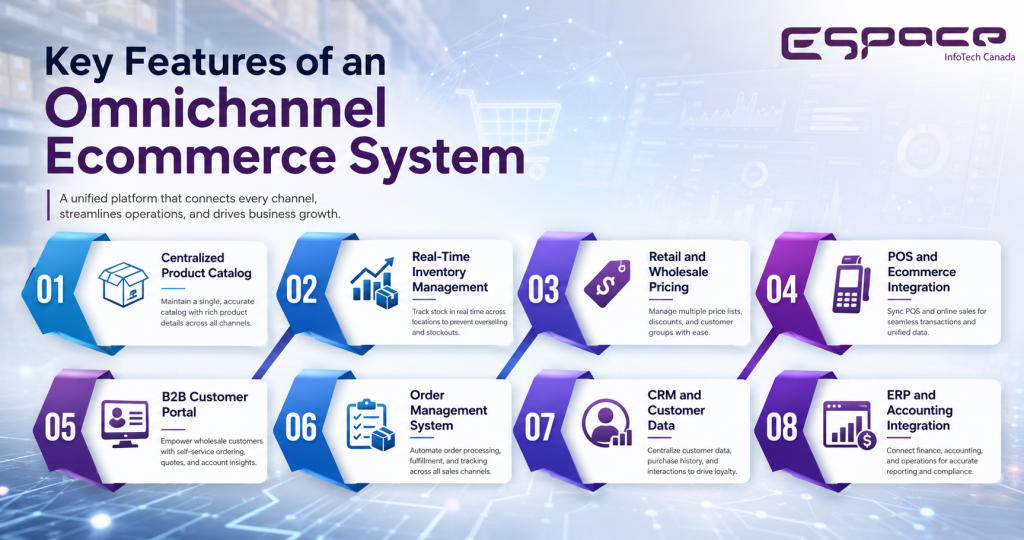
Centralized Product Catalog
Your product catalog should be managed from one central system. Product names, SKUs, images, descriptions, categories, variants, and availability should remain consistent across the website, POS, wholesale portal, and other sales channels.
This reduces confusion and helps every channel show accurate product information.
Real-Time Inventory Management
Inventory accuracy is one of the most important parts of omnichannel ecommerce. If a customer places an order for a product that is already out of stock, trust drops quickly.
Your platform should update stock in real time across online stores, retail locations, warehouses, and wholesale orders. Useful features include low-stock alerts, stock reservation, backorders, and multi-location inventory tracking.
Retail and Wholesale Pricing
Retail and wholesale pricing usually work differently. Retail customers may see standard prices, offers, and discount codes. Wholesale buyers may need bulk pricing, customer-specific pricing, tiered pricing, or contract-based rates.
A proper omnichannel ecommerce system should support different pricing rules for different customer groups. This allows one platform to serve both B2C and B2B buyers without creating separate disconnected systems.
POS and Ecommerce Integration
For businesses with physical stores, POS integration is essential. Online and offline sales should not operate in separate silos.
When a product is sold in-store, website inventory should update. When a customer places an online order for store pickup, the store team should receive the order instantly. This reduces manual work and keeps operations smooth.
B2B Customer Portal
Wholesale customers need more than a basic checkout page. They may require company accounts, saved order lists, quick reorder options, invoice payments, quote requests, purchase order support, and approval workflows.
A B2B customer portal makes wholesale ordering faster and more professional. It also helps sales teams spend less time collecting orders manually.
Order Management System
Orders may come from websites, stores, marketplaces, wholesale portals, or sales representatives. A strong order management system allows your team to manage all orders from one dashboard.
It should support order routing, delivery tracking, store pickup, returns, refunds, and order status updates.
CRM and Customer Data
Customer data helps businesses understand buying behavior and improve communication. Your system should store customer profiles, order history, communication records, loyalty details, and account information in one place.
For retail businesses, this supports personalized marketing. For wholesale businesses, it helps sales teams manage key accounts more effectively.
AI Implementation in Ecommerce Platform
AI can improve a ecommerce platform by making workflows smarter and faster. Key implementations include AI-powered inventory recommendations, lead scoring, chatbot support, CRM follow-up insights, document assistance, and AI reporting. These features help you focus on serious clients, reduce manual work, answer common questions faster, organize documents, and turn platform data into simple business insights.
ERP and Accounting Integration
ERP integration is important for businesses that manage finance, procurement, suppliers, invoices, inventory, and business records. Connecting ecommerce with ERP reduces duplicate work and helps maintain cleaner data across departments.
How to Build an Omnichannel Ecommerce System
Start by auditing your current sales channels. Identify where your sales happen today, such as your website, store, wholesale process, marketplace, social media, or manual order system. Then look for gaps in inventory, pricing, fulfillment, reporting, and customer management.
Next, define separate requirements for retail and wholesale buyers. Retail may need fast checkout, mobile payment, delivery tracking, and promotions. Wholesale may need bulk order forms, account-based pricing, purchase orders, invoice payments, and approval workflows.
After that, choose the right platform approach. A SaaS ecommerce platform can be useful for a quick launch. However, if your business has complex pricing, POS integration, ERP workflows, multi-location inventory, or wholesale ordering needs, custom ecommerce development may be a better long-term option.
Before development starts, plan your product and pricing structure clearly. Define SKUs, categories, customer groups, pricing rules, volume discounts, minimum order quantities, and product visibility rules.
Then connect your inventory, POS, warehouse, and wholesale portal early in the process. Accurate stock data helps prevent overselling and improves fulfillment speed.
Your checkout flow should also match the buyer type. Retail checkout should be simple and fast. Wholesale checkout may need purchase orders, quote requests, invoice payments, or approval steps.
You should also integrate payment gateways, shipping providers, tax rules, invoice generation, and delivery tracking. These integrations make order processing smoother for your team and more transparent for customers.
Finally, build a clear admin dashboard with useful reports. Important reports may include sales by channel, inventory status, order performance, returns, customer activity, and wholesale account growth.
Before launch, test the complete journey. Check online orders, store pickup, wholesale ordering, payment, stock sync, returns, invoice generation, and customer notifications. A soft launch can help your team identify issues before scaling.
Security and Privacy for Real Estate SaaS in Canada
Real estate platforms collect personal information such as names, contact details, property preferences, communication history, uploaded documents, and sometimes financial information.
Canada’s PIPEDA sets the ground rules for how private-sector organizations collect, use, and disclose personal information during commercial activities. Because of this, privacy and security should be planned from the beginning.
When Should You Choose Custom Ecommerce Development?
Custom ecommerce development is useful when your business needs more flexibility than ready-made platforms can offer.
You may need a custom solution if your business manages multiple warehouses, retail and wholesale pricing, ERP integration, POS integration, custom order workflows, sales representative ordering, or advanced reporting.
A custom-built platform can be designed around your actual business process. It gives you better control, smoother integration, and more room to scale.
Conclusion
An omnichannel ecommerce system is more than an online store. It is a complete business platform that connects sales, inventory, customers, payments, fulfillment, and reporting.
For retail and wholesale businesses, it can reduce manual work, improve inventory accuracy, support better customer experiences, and create a stronger foundation for long-term growth.
If you are planning to build a scalable omnichannel ecommerce system, working with an experienced custom ecommerce development team can help you choose the right architecture, connect your existing tools, and build a platform that supports your next stage of growth. Espace Infotech Canada Inc. helps ecommerce businesses and startups build scalable digital platforms with customer management, CRM integration, automation, and growth-ready ecommerce solutions.